AI architecture services for organizations that need structure before scale.
AKANON helps organizations understand where AI belongs, design the systems required, support deployment, and govern those systems as they evolve.
The AKANON service path
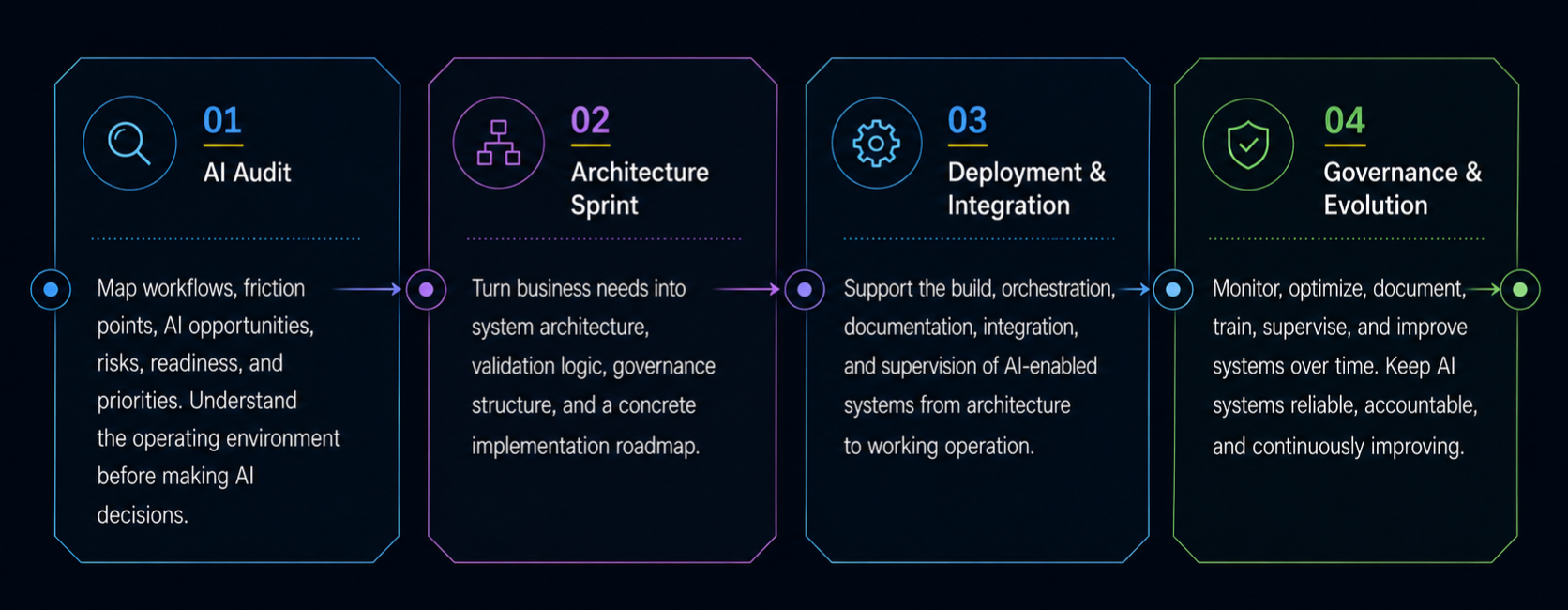
The work begins before tools are selected. AKANON first understands the business, workflows, constraints, risks, and execution environment. Then the architecture is designed around real operational needs — not around tool availability or platform defaults.
Strategic AI Audit
Understand the current operating environment before making AI decisions. AKANON maps what exists, where friction appears, what risks are present, and which opportunities are worth pursuing.
What it examines
- ◆ Current workflows and information flows
- ◆ Existing tools and system interactions
- ◆ Operational friction and bottlenecks
- ◆ AI readiness and governance gaps
- ◆ Implementation risks and priority opportunities
Possible outputs
"The right first step is usually an audit. Understanding the environment before designing the system is not a best practice — it is a prerequisite."
— AKANON SYSTEMS
Possible outputs
Architecture Sprint
Convert diagnosis into a concrete AI system blueprint. The Architecture Sprint translates business needs, workflows, and constraints into a structured system design that teams and partners can build against.
What it defines
- ◆ System logic and AI roles
- ◆ Human validation points and decision checkpoints
- ◆ Data and tool requirements
- ◆ Governance structure and implementation roadmap
- ◆ Workflow architecture and execution path
Deployment & Integration
Support the move from architecture to working system. AKANON supports deployment and integration with internal teams, external technical partners, or selected implementation collaborators.
What it supports
- ◆ Build coordination and technical partner alignment
- ◆ AI workflow orchestration and documentation
- ◆ Implementation supervision and testing
- ◆ Internal adoption support and integration alignment
Possible outputs
Possible outputs
Retainer model
Governance & Evolution is designed as an ongoing retainer: sustained oversight, continuous improvement, and systematic documentation rather than one-time delivery.
Governance & Evolution Retainer
Keep systems reliable, documented, supervised, and improved after launch. Governance is not an afterthought — it is a design principle that runs throughout the AKANON method.
What it supports
- ◆ Monitoring, optimization, and documentation
- ◆ Governance reviews and access control
- ◆ Adoption support and team training
- ◆ Quality control and continuous improvement
What a mandate can produce
Depending on the mandate, AKANON may produce strategic, operational, and technical deliverables that help teams move from uncertainty to structured execution.
AI opportunity map
A structured view of where AI fits, where it adds value, and where the risks lie.
Workflow & friction analysis
Mapped workflows with friction points, handoff logic, and AI integration opportunities identified.
System architecture blueprint
A complete AI system design with logic, roles, validation, and data requirements.
Implementation roadmap
A sequenced path for building, deploying, and validating the designed system.
Governance & validation framework
Documentation, review protocols, validation logic, and accountability structures.
Technical requirements brief
Structured specifications for technical partners or internal development teams.
Adoption & documentation support
Materials and guidance to help teams adopt, operate, and understand the systems built.
Optimization recommendations
Ongoing analysis of system performance with structured improvement recommendations.
Built for organizations that need AI structure, not AI noise.
SMEs & growing businesses
Organizations scaling operations and needing AI structure before complexity outgrows capacity.
Mid-market organizations
Teams with existing tools, fragmented workflows, and the need for coherent AI architecture.
Service companies
Professional services firms with high-value workflows that benefit from systematic AI integration.
Operational teams
Teams with complex workflows that need clarity on where AI belongs and what should remain human-led.
AI product teams
Founders and product teams building AI-enabled products who need architecture before engineering.
Mission-driven organizations
NGOs and institutional organizations exploring responsible AI adoption with governance from the start.